
A number of antique collectors and dealers utilize Long Wave Ultraviolet (LWUV) Black Lights to test antiques and collectibles for signs of repair and authenticity that may not be visible to the naked eye. Although black lights are a necessary tool, they should not always be considered the “be all and end all” in determining the authenticity of antique and vintage items. This is not to say, however, that long wave ultraviolet black lights are useless, as they are not. And they should be an essential part of any collector’s or dealer’s “road pack” (that small pack of tools that every dealer, collector and junker or picker takes with them on the road in search of treasures).
Of the many uses of the long wave UV black light, here are some of the most common that the collector, dealer, or junker may encounter.
1. Testing Porcelain, China and Pottery
Quite often, I have found that I have purchased a piece of china or pottery, only to find at a later date that the piece had been broken and repaired so expertly, that I neither felt or saw the repair. Later, however, when exposed to a black light, the repair was easily seen. Not only will most modern glues used in repairing items such as this fluoresce, but so will many modern paints that are used to cover such repairs and fill any minute cracks left over after repairing the piece. Black light testing will also reveal fine hairline cracks and “flea bites” (very small minute chips or flakes) in porcelain that are not readily visible to the naked eye.

2. Testing Glass
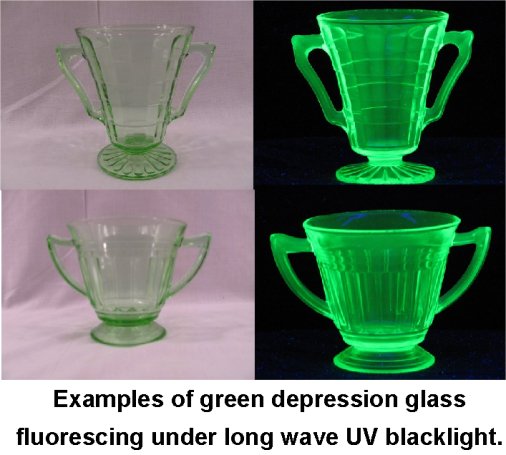
Green depression era glass contains manganese, and Vaseline glass contains uranium oxide, as part of the manufacture process. Both of these compounds will cause the glass to fluoresce a bright green when exposed to a LWUV black light. Reproduction depression glass, and glass from the late 1940’s and newer will not fluoresce. At least as a general rule. It should be noted, however, that Vaseline glass is still being made, and it still glows a bright green under LWUV black light. Vaseline glass can be easily identified by its bright yellowish green appearance (or opaque Vaseline colored look – hence the name, as found in custard glass). When it comes to Vaseline glass, a LWUV black light is more reliable in determining when an item is NOT true Vaseline glass.

As a general rule, Lalique art glass made prior to 1945 will fluoresce yellow, while similar glass manufactured post-war will not. The same is true for antique Burmese glass, and opalescent glass. Both will fluoresce while the newer reproductions will not
Early American Pattern Glass (EAPG) and American Brilliant Period Cut Glass (ABP) will also fluoresce, although not always as brightly. Most will fluoresce a pale yellow green when exposed to LWUV black light. There are those who say that these types of clear glass will glow a faint purple or blue. This is likely not a true fluorescence, however, and more likely a reflection of the lamp itself, indicating that the glass is likely a newer piece.

A word of warning when testing EAPG or ABP glass with a LWUV black light. Quite often, reproduction pieces have been created using what is known as “cullet” glass. Cullet glass is simply large pieces of broken or damaged original EAPG or ABP glass, that has been melted, mixed, and re-molded into a new piece. This new reproduction will glow under LWUV black light, and it will be virtually identical to an original piece. All that is necessary for a reproduction piece to glow, is a small amount of original Vaseline glass mixed into the cullet mixture.
Because of this, it is imperative that black light testing not be the sole determining factor in dating colorless glass in an EAPG or ABP pattern. Other factors must be taken into account such as weight, size, cut, and of course, provenance.
A further word of warning regarding LWUV black light testing of clear EAPG and ABP glass. Some of pieces of EAPG and ABP glass will not fluoresce, and some will fluoresce an electric blue, and some will fluoresce pink (indicative of a high percentage of lead, such as in lead crystal). So again, it is imperative to do your research, and know your glass when purchasing EAPG and ABP.
3. Testing Works of Art
I must admit that I am not an art collector, nor am I am art expert. However, it is commonly known that most modern paint will fluoresce under LWUV black light, thereby making it relatively easy to spot touch ups and repairs in pieces of art. If you are serious about becoming an art collector, I would strongly recommend taking some classes and purchasing some good books regarding the collecting of fine art, before purchasing expensive art work.

4. Testing Ephemera and Paper Items
Paper products made before the late 1930’s will rarely fluoresce when exposed to LWUV, however, when it does, it may appear faintly whitish, yellowish, or even grayish. Conversely, chemicals used in the production of modern paper will glow brightly under a black light. Quite often old documents will contain what is known as “foxing” which is the presence of mildew. LWUV will cause the foxing to appear yellowish, and will show water stains that may not be easily seen otherwise. Old vellum (which is parchment made from lambskin, goatskin, or calfskin) will appear yellowish white or ivory when exposed to LWUV, where conversely, modern vellum will glow bluish white.
5. Testing Textiles and Fabrics
Most (although not all) old textiles will not fluoresce when exposed to LWUV black light. Conversely, many (although again not all) modern fibers such as rayon and polyester will fluoresce when exposed to LWUV black light. This includes modern sewing thread. This can help in both dating and locating repairs in vintage clothing, quilts, stuffed animals and toys (such as teddy bears and rag dolls), as well as other items made of cloth. The general rule of thumb being if it glows, it isn’t old (the opposite of antique and vintage glass).
However, this being said, as with other items being tested with LWUV black light, there will be situations where old cloth may fluoresce. Modern laundry detergents contain additives designed to brighten fabrics. If a vintage fabric (clothing, quilt, etc.) is washed using one of these products, there is a very good chance that it will glow brightly when exposed to a black light. In addition, there are some modern fabrics which do not fluoresce when exposed to a black light.
With this in mind, it should be remembered that when testing textiles and fabrics with a LWUV black light, it should only be considered a presumptive test, as you may get “false positive” or “false negative” result. More important than a black light test, one should also consider manufacturing techniques, design, materials, and provenance when identifying textiles or fabrics.
6. Testing Cast Iron Items
Antique and vintage cast iron items, such as banks, book ends, door stops and more, were often painted, or contained painted decoration. Original items with original paint are often highly collectible and may be quite valuable. As mentioned earlier with regard to testing art work, most modern paints will fluoresce when exposed to LWUV black light. Testing allegedly old cast iron items that have been painted may reveal modern paint (which could indicate either a new or refinished piece), or, testing may reveal old paint that has been “touched up” with modern paint either to enhance the piece, or to cover a repair.
As with the testing of other items with a black light, it is always best not to rely completely on a black light test. Always remember to do your research, and completely examine the piece for other signs of authentic age.
7. Testing Stones and Gemstones
Many minerals, including opal, flurite, calcite, ruby, emerald, dolomite, quartz, and others will glow when exposed to LWUV black light. In stones, this is known as photoluminescence. Black light testing of stones and gemstones can in some cases, reveal whether or not the stone or gemstone is authentic or some other material designed to appear as a stone or gemstone.
8. Testing Marble, Jade, Ivory, Bone
Many antiques, such as clocks, knives, carved pieces and more, are made of marble, jade, ivory and bone. In determining the age of these items, as well as discovering if portions of these pieces have been replaced, a black light is a good place to start. Fresh cut marble, limestone and alabaster do not fluoresce significantly, and may appear purple in color. Old marble will often appear mottled white. Freshly carved jade will have an intense color, whereas similar to old marble, old jade will appear mottled. Freshly carved ivory and bone will appear purple, however, an antique piece of ivory or bone will appear yellow.
Items that have been repaired or restored will be seen as such when exposed to a black light. Glues used in repairs, as well as wax and plaster used as filler will be shown to fluoresce differently than then the original sections of the repaired or restored piece. If the face of an antique clock appears bright white when exposed to a black light, there is a very good chance that the clock face is not original to the case.
As can be seen in this article, although a LWUV black light can be a useful tool for testing antiques and collectibles, it cannot and should not be the only source of authentication. Nothing can replace proper research, and it is very important to have a firm understanding of the item you are considering purchasing.
It should also be noted that throughout this article, I have used constantly used the term LWUV black light. The reason for this is the personal safety of the reader. When testing items with a black light it is important to ALWAYS and ONLY use a Long Wave Ultraviolet Black Light. There are three types of black lights available. These are UV-A, commonly known as a Long Wave UV black light; a UV-B, also known as a medium wave UV black light; and a UV-C, also known as a short wave (or far ultraviolet or germicidal) UV black light. Long term exposure to both UV-B and UV-C black lights can lead to serious and irreversible skin and vision problems such as cataracts, glaucoma, and macular degeneration. Therefore, ALWAYS and ONLY use a Long Wave Ultraviolet Black Light when testing antiques and collectibles.
For further information on testing antiques and collectibles with a black light, I highly recommend purchasing The Black Light Book for Antiques and Collectibles. It is a highly informative book, containing over 100 photos and illustrations. Should you need a LWUV Black Light for yourself, there are several good online sources, including:
http://www.theblacklightbook.com
http://www.uvp.com


